Animated GIF Balancing a Broomstick on Your Finger: The Fascinating Science, Physics, and Skill Behind This Classic Trick
Introduction to Animated GIF Balancing a Broomstick on Your Finger
An Animated GIF Balancing a Broomstick on Your Finger is a fascinating visual demonstration of balance, coordination, physics, and human concentration. At first glance, the activity may appear simple: someone places the bottom end of a broomstick on the tip of one finger and attempts to keep it standing upright without allowing it to fall. However, when viewed more closely, this small experiment reveals an interesting combination of scientific principles and physical skills. The broomstick constantly responds to tiny movements, and the person balancing it must make quick adjustments to keep it from tipping over. An animated GIF captures these movements in a short, repeating visual sequence, allowing viewers to observe the challenge from beginning to end.
The popularity of this activity comes from its simplicity and visual appeal. A broomstick is an ordinary household object that most people recognize, while balancing it on a single finger creates an unusual and entertaining challenge. The animated format makes the demonstration even more engaging because viewers can repeatedly watch the broomstick move from side to side while the person tries to maintain control. It can be interesting for children, students, teachers, science enthusiasts, and anyone who enjoys simple physical experiments. Beyond entertainment, the activity provides an accessible introduction to concepts such as the center of mass, gravity, stability, reaction time, and rotational motion.
What Is Animated GIF Balancing a Broomstick on Your Finger?
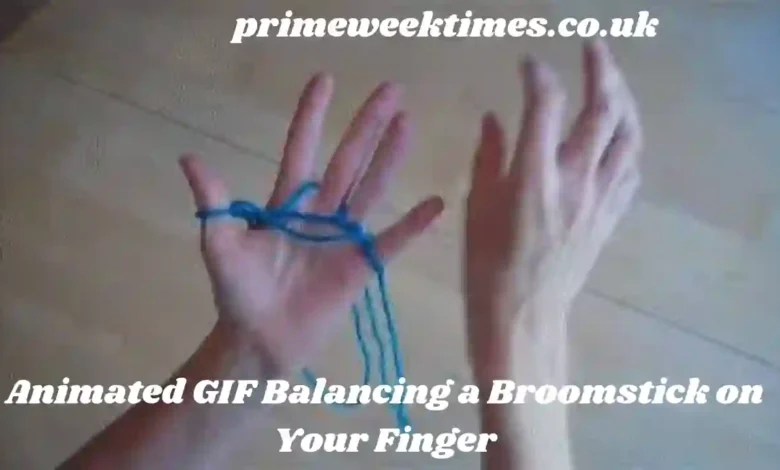
Animated GIF Balancing a Broomstick on Your Finger describes a looping animation that demonstrates a person attempting to balance a broomstick vertically using only one finger as the supporting point. The broomstick is positioned upright, with one end resting against the fingertip. As the stick begins to lean in one direction, the person moves their finger underneath it to prevent it from falling. This process continues through a series of small adjustments until the broomstick remains balanced or eventually loses stability.
Unlike a photograph, which captures only one moment, an animated GIF shows movement through several consecutive frames. This makes it easier to understand how balancing works because viewers can observe the relationship between the broomstick’s position and the person’s hand movements. The animation may show the stick leaning slightly to the left, moving toward the right, returning to the center, and repeating the same motion.
The visual simplicity of this GIF is one of its strongest qualities. There is no complicated equipment, expensive technology, or special environment required to understand the demonstration. The main elements are a broomstick, a fingertip, gravity, and the person’s ability to react to changes in position. Even a short animation can communicate an interesting scientific idea without requiring a lengthy explanation.
The Science Behind Balancing a Broomstick on Your Finger
The science behind balancing a broomstick on your finger is connected to classical mechanics, particularly the study of forces, motion, and rotational stability. When a broomstick stands vertically, gravity pulls its mass downward toward the ground. The fingertip provides an upward supporting force that helps prevent the broomstick from falling. However, maintaining this position requires more than simply holding the stick in one place.
A perfectly upright broomstick is in a delicate equilibrium. If its center of mass moves away from the supporting point, gravity creates a turning effect that causes the stick to rotate and fall. The person balancing it must recognize this movement and shift their finger in the appropriate direction. These adjustments help keep the supporting point underneath the broomstick’s center of mass.
The process becomes easier to understand when watching an Animated GIF Balancing a Broomstick on Your Finger repeatedly. Each small movement demonstrates how the object responds to changes in its position. Although the adjustments may look almost automatic, they involve continuous visual observation and physical coordination.
The experiment also demonstrates that balance is not always a completely motionless condition. In many practical situations, maintaining balance involves continuous movement and correction. Human beings perform similar adjustments when standing, walking, riding bicycles, and carrying objects.
Understanding the Center of Mass
The center of mass is one of the most important concepts in this balancing experiment. It refers to the point at which an object’s mass can be considered concentrated for understanding its overall motion. For a broomstick, the center of mass depends on its length, weight distribution, handle, and bristle arrangement.
When the broomstick is balanced vertically, the supporting finger must remain approximately underneath its center of mass. If the finger moves too far away from this position, the broomstick begins to rotate. This is why balancing requires constant attention to the relationship between the fingertip and the object’s overall position.
A broomstick with uneven weight distribution may have a center of mass closer to its heavier end. This can influence how easily it balances and how quickly it responds to movement. Understanding this principle helps explain why different objects behave differently during balancing experiments.
The center of mass is also important in many everyday activities. Athletes use body positioning to maintain stability, construction engineers consider weight distribution when designing structures, and performers adjust their movements when balancing objects. The broomstick experiment provides a simple way to explore the same underlying idea.
Why a Longer Broomstick Can Be Easier to Balance
One interesting feature of this experiment is that a longer broomstick can sometimes be easier to balance than a shorter object. This may seem surprising because larger objects appear more difficult to control. However, the length of an object influences how quickly it rotates when it begins to lean.
A longer broomstick generally has a greater rotational inertia around its supporting point than a short stick with a similar mass distribution. Rotational inertia describes how strongly an object resists changes in its rotational motion. As a result, a longer broomstick may begin tipping more slowly, giving the person additional time to notice its movement and make a correction.
This additional reaction time can make a noticeable difference. When balancing a short pencil on a fingertip, even a tiny movement can quickly cause it to fall. A longer object may respond more gradually, allowing the person to follow its movement with their hand.
However, length alone does not determine difficulty. Weight distribution, total mass, the shape of the object, and the person’s coordination all influence the result. A very heavy or awkwardly shaped broomstick may be more challenging despite its length.
The Role of Gravity in the Balancing Challenge
Gravity is the force that makes the broomstick fall whenever it moves away from its balanced position. It acts continuously, pulling the broomstick toward the ground. Without the supporting force from the fingertip, the object cannot remain suspended in an upright position.
When the broomstick begins leaning, gravity produces a torque around the supporting point. Torque is the turning effect of a force, and it is responsible for the rotational movement that causes the stick to fall. The farther the center of mass moves horizontally from the supporting point, the greater the gravitational turning effect becomes.
The person balancing the broomstick must therefore move their hand to reduce the distance between the supporting point and the changing position of the center of mass. This action does not remove gravity. Instead, it changes the position of the support to maintain control.
An Animated GIF Balancing a Broomstick on Your Finger can make this scientific principle easier to visualize. Viewers can observe the object leaning and the fingertip following its movement. This simple interaction illustrates how gravity influences everyday objects and why maintaining balance requires continuous adjustments.
Hand-Eye Coordination and Reaction Time
Balancing a broomstick on one finger is not only a physics experiment. It is also a demonstration of hand-eye coordination and reaction time. The eyes observe the broomstick’s position, the brain processes the information, and the muscles move the hand to make a correction.
This sequence happens repeatedly throughout the activity. When the broomstick leans to one side, the person must recognize the direction of movement and adjust their fingertip accordingly. If the correction happens too late, the broomstick may fall before the supporting point returns underneath its center of mass.
Hand-eye coordination is important in many everyday activities. Writing, catching a ball, playing sports, using tools, and performing delicate tasks all involve communication between visual information and physical movement.
The broomstick challenge offers an entertaining opportunity to practice these skills. Although it should not be considered a formal medical or athletic training method, it can encourage concentration, patience, and awareness of movement.
How to Balance a Broomstick on Your Finger
Learning to balance a broomstick on your finger becomes easier when the activity is approached gradually. Beginners should start with a lightweight broomstick or a long, smooth wooden stick. A clean and safe object is preferable because rough surfaces, sharp edges, and loose components can make the experiment uncomfortable or dangerous.
Begin by standing in an open area with enough space around you. Hold the broomstick vertically and place one end gently on the tip of your index finger. Keep your other hand nearby in case you need to catch the object. Avoid starting with sudden movements because the goal is to understand how the broomstick responds to small changes.
Once the broomstick is positioned upright, focus your eyes on its upper section rather than looking only at your fingertip. This can make its direction of movement easier to recognize. If the top begins moving toward the left, move your supporting hand toward the direction in which the object is leaning so that your finger stays underneath its center of mass.
Continue making small adjustments rather than large, sudden movements. The broomstick may move slightly from side to side before you begin developing a better sense of its motion. With practice, you may become more comfortable recognizing the direction in which it is beginning to fall.
The most important part of the exercise is patience. Beginners may lose balance repeatedly, but every attempt provides information about how the object moves. Starting with a shorter practice session and gradually increasing the duration can make the experience more enjoyable.
Common Mistakes Beginners Make
One of the most common mistakes is trying to keep the broomstick completely motionless. Beginners often believe that the finger must remain perfectly still beneath the object. In reality, maintaining balance requires continuous movement because even a small change in the broomstick’s position can affect its stability.
Another mistake is making corrections that are too large. When the broomstick starts leaning, a person may quickly move their hand too far in the opposite direction. This can cause the object to lean in another direction, creating an exaggerated back-and-forth movement.
Looking only at the fingertip can also make the challenge harder. The broomstick’s upper end provides useful visual information about the direction in which the entire object is moving. Watching its movement can help the person make more appropriate corrections.
Some beginners also choose objects that are too heavy or uncomfortable to hold. A lightweight practice stick is usually more suitable for learning the basic technique. Choosing a manageable object makes it easier to focus on coordination instead of struggling with its weight.
Finally, giving up after a few unsuccessful attempts can prevent beginners from understanding the movement. Balance is a skill that develops through observation and repetition. A relaxed approach usually makes the experiment more enjoyable.
Why Animated GIFs Make the Experiment More Interesting
Animated GIFs are particularly effective for demonstrating activities that involve repeated movement. A single photograph of a broomstick standing on a finger cannot show how the person maintains balance. It captures only one moment, leaving viewers unable to understand the adjustments taking place.
An animation solves this problem by presenting several moments in a continuous sequence. Viewers can watch the broomstick begin to lean, observe the supporting hand moving, and see the object return toward an upright position. The looping format allows the same action to repeat without requiring viewers to restart a video.
The short and accessible nature of GIFs also makes them useful for educational and entertainment purposes. They can be shared in online discussions, classroom presentations, educational posts, and social media content. Their visual format makes complicated movements easier to understand, particularly when the demonstration is simple enough to communicate without narration.
An Animated GIF Balancing a Broomstick on Your Finger can also attract attention because the outcome is not always predictable. Viewers may wonder whether the person will successfully maintain balance or whether the broomstick will eventually fall. This small element of suspense makes the animation more engaging.
Educational Benefits of the Broomstick Experiment
The broomstick balancing activity can be used as a practical classroom demonstration. Teachers can introduce students to basic physics concepts using an object that is easy to recognize and understand. Instead of learning only through written definitions, students can observe how forces and motion interact in a real situation.
For example, students can compare a short stick with a longer broomstick and discuss why the objects respond differently when tilted. They can also experiment with different weight distributions to observe how the location of the center of mass affects balance.
Another useful classroom activity involves asking students to predict what will happen before an object begins moving. They can observe the result and compare their predictions with the actual movement. This encourages curiosity, scientific reasoning, and critical thinking.
The experiment is also suitable for introducing basic vocabulary such as gravity, torque, equilibrium, rotational inertia, and center of mass. Students do not need advanced mathematical knowledge to understand the main principles. A simple demonstration can provide a useful starting point for more detailed lessons about mechanics.
Different Objects You Can Use for Finger Balancing
Although the traditional activity involves a broomstick, the same basic idea can be explored with several other objects. A long wooden dowel, lightweight plastic rod, ruler, or suitable practice stick may also be used.
A pencil is another familiar object, although its short length generally makes the challenge more difficult. A longer ruler can provide a different experience because its weight distribution and rotational properties may be different from those of a broomstick.
Students can also compare objects of similar lengths but different weights. This creates an opportunity to investigate how mass distribution influences stability. For example, a lightweight plastic rod and a heavier wooden stick may respond differently when placed on the same supporting point.
The most important consideration is safety. Objects should be smooth, lightweight, and free from sharp edges. Heavy household tools, damaged broomsticks, and objects with loose metal parts should not be used for finger-balancing experiments.
How to Create an Engaging Animated GIF
Creating an Animated GIF Balancing a Broomstick on Your Finger can be a straightforward creative project. The first step is to record a short demonstration using a smartphone or digital camera. The camera should remain steady so viewers can clearly observe the movement of the broomstick and the supporting hand.
Good lighting is important because it makes the object easier to distinguish from the background. A simple, uncluttered setting can also improve the visual quality of the animation. The broomstick should remain visible throughout the recording, including when it begins leaning toward either side.
After recording, the footage can be trimmed to show the most interesting part of the demonstration. A short sequence showing the broomstick moving from side to side and returning toward an upright position may be particularly effective.
The selected footage can then be converted into a GIF using an appropriate editing application. Adjusting the playback speed, cropping unnecessary background space, and selecting a suitable frame rate can help create a smoother result.
A repeating loop is especially useful for this subject because it allows viewers to study the balancing movement several times. However, the transition between the final and first frames should look reasonably natural so that the animation does not feel unnecessarily interrupted.
The Difference Between Balance and Stability
Balance and stability are closely related concepts, but they do not mean exactly the same thing. Balance describes a condition in which the forces and turning effects acting on an object are appropriately controlled. Stability describes how an object responds when it experiences a small disturbance.
A broomstick balanced vertically on a fingertip is an example of an unstable equilibrium. If the object is disturbed slightly, gravity tends to make it move farther away from its original upright position unless the supporting point is adjusted.
By comparison, a broomstick with a wide and stable base may return to its original position after a small disturbance. This is an example of a more stable arrangement.
The distinction is important because the finger-balancing activity requires active control rather than relying on the object’s natural stability. The person must constantly adjust the supporting point to prevent the broomstick from falling.
This concept is relevant to many practical situations, including architecture, engineering, sports, and the design of everyday objects.
Why Practice Makes the Balancing Trick Easier
Practice helps people become more familiar with the way a particular object moves. During the first few attempts, beginners may struggle to identify whether the broomstick is beginning to lean forward, backward, or sideways. With repeated practice, these movements may become easier to recognize.
The brain gradually becomes more familiar with the visual signals associated with the broomstick’s movement. The person may begin responding more quickly and making smaller corrections instead of relying on large movements.
Regular practice can also improve confidence. When beginners understand that the broomstick does not need to remain perfectly motionless, they may become more comfortable allowing small movements while maintaining control.
It is useful to practice in short sessions rather than attempting to balance the object for an unnecessarily long time. Taking breaks helps prevent frustration and keeps the activity enjoyable.
The goal should not be to achieve an impressive result immediately. Understanding the movement and learning how to respond to small changes are valuable parts of the experience.
Social Media Appeal of Animated GIF Balancing a Broomstick on Your Finger
Short visual demonstrations have an important place in modern digital communication. People often enjoy content that presents an interesting action without requiring a lengthy explanation. A broomstick balancing on a fingertip fits this format because the activity is recognizable, visually unusual, and easy to understand.
An animated GIF can communicate the entire concept within a few seconds. The viewer immediately recognizes the broomstick and notices the unusual way it is being supported. The continuous movement creates curiosity, encouraging people to watch the animation more than once.
This type of content can be useful for educational pages, science communities, entertainment websites, and social media accounts. A caption explaining the physics behind the movement can add educational value, while a simple question can encourage viewers to share their own experiences.
For example, a post might ask whether viewers have ever attempted to balance a broomstick on one finger. This creates an opportunity for people to discuss their attempts, compare techniques, and share interesting observations.
The strongest appeal of this activity is its combination of simplicity and science. It does not depend on expensive equipment or complicated visual effects to capture attention.
Interesting Facts About Broomstick Balancing
Broomstick balancing connects several scientific ideas that are often studied separately. Gravity, torque, rotational inertia, equilibrium, and human reaction time all contribute to the final result.
One interesting fact is that the location of the center of mass can matter more than the object’s overall appearance. Two broomsticks that look almost identical may behave differently if their weight distribution is not the same.
Another interesting observation is that a longer object can sometimes provide more time for corrections because of its greater rotational inertia. This is one reason why balancing a long stick may feel easier than balancing a short pencil.
The activity also demonstrates that balance is a dynamic process. A person does not simply place a finger underneath the broomstick and wait. Instead, the supporting hand moves continuously to maintain the correct relationship between the support and the object’s center of mass.
Finally, a simple animated demonstration can introduce scientific concepts that are used in advanced engineering and mechanical design. This makes the activity an interesting example of how everyday experiences can reveal important principles of science.
Safety Tips for Trying the Broomstick Balancing Trick
Safety should always be considered before attempting the activity. Although balancing a broomstick is generally a simple experiment, using an unsuitable object or practicing in a crowded area can create unnecessary risks.
Choose a lightweight broomstick or smooth practice rod without sharp edges, loose components, or damaged sections. Avoid using a heavy commercial broom with an uncomfortable handle or unstable parts.
Practice in an open space away from glass objects, electronic equipment, pets, and other people. Make sure there is enough room for the broomstick to fall without damaging anything.
Beginners should keep their free hand nearby so they can catch the object if it begins to fall. Avoid attempting the trick while standing on furniture, climbing stairs, or moving around.
Children should perform the activity with appropriate adult supervision, especially when using a full-sized broomstick. The experiment should remain simple, controlled, and enjoyable.
Conclusion: The Science and Entertainment of Animated GIF Balancing a Broomstick on Your Finger
Animated GIF Balancing a Broomstick on Your Finger is more than a simple visual trick. It is an entertaining demonstration of physics, coordination, concentration, and the relationship between gravity and motion. By observing how a person keeps a broomstick upright using only one fingertip, viewers can explore important scientific concepts in a practical and accessible way.
The experiment demonstrates how the center of mass, torque, and rotational inertia influence the movement of everyday objects. It also highlights the importance of hand-eye coordination and quick corrections when maintaining balance. Although the activity may appear effortless when performed successfully, it requires continuous observation and careful adjustments.
Animated GIFs make the demonstration even more interesting by presenting the movement in a short, repeating sequence. They allow viewers to observe the balancing process, understand the movement, and appreciate the science behind an ordinary household object.
Whether used for entertainment, educational activities, science demonstrations, or social media content, this experiment offers something interesting for different audiences. Its greatest strength is that it turns a familiar object into an opportunity for discovery. A simple broomstick, one finger, and a little patience are enough to demonstrate how fascinating the science of balance can be.
Frequently Asked Questions (FAQs)
1. What Is Animated GIF Balancing a Broomstick on Your Finger?
Animated GIF Balancing a Broomstick on Your Finger is a looping visual demonstration showing a person keeping a broomstick upright using one fingertip. It illustrates balance, gravity, coordination, and the movement of an object around its supporting point.
2. Why Is a Long Broomstick Sometimes Easier to Balance?
A longer broomstick can have greater rotational inertia than a shorter object with a similar mass distribution. This can make its rotational movement slower, giving the person more time to recognize changes and adjust their supporting finger.
3. What Is the Science Behind Balancing a Broomstick?
The activity involves gravity, torque, the center of mass, and rotational inertia. The person must keep their supporting finger underneath the changing position of the broomstick’s center of mass to prevent it from falling.
4. Can Beginners Learn to Balance a Broomstick on One Finger?
Yes. Beginners can start with a lightweight stick, practice in an open area, and make small adjustments as the object moves. Repeated attempts can help develop better coordination and familiarity with the balancing process.
5. Why Are Animated GIFs Useful for Showing This Experiment?
Animated GIFs display movement through a repeating sequence of images. This makes it easier for viewers to observe how the broomstick leans, how the supporting hand responds, and how balance is maintained throughout the demonstration.
ALSO READ : Abijah Sirayon Harvard LinkedIn: Background, Education and Career