
Weathering With You Room for Only 280 Yen: The Real Meaning Behind the Famous Scene
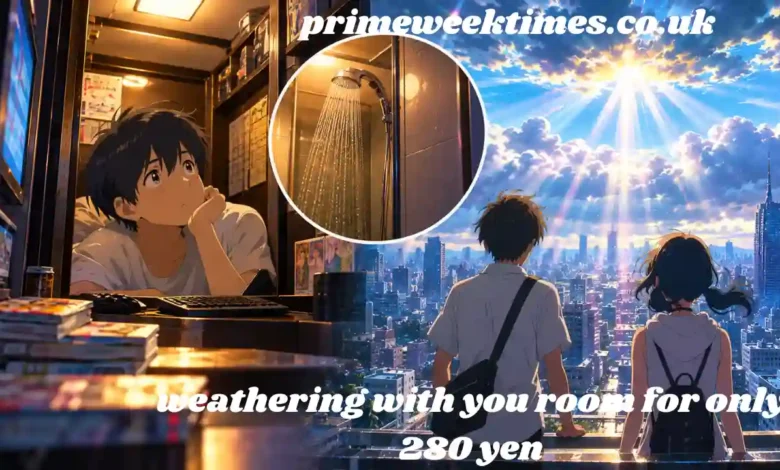
Weathering with You room for only 280 yen is a phrase that has attracted attention from anime fans because it appears to connect one of Makoto Shinkai’s most memorable films with an unbelievably cheap place to stay in Tokyo. At first glance, the idea sounds almost too good to be true: a room in Tokyo for only 280 yen. However, there is an important detail behind the phrase that makes the scene much more interesting. The 280-yen amount is associated with a shower at the manga café where Hodaka stays, rather than being the full price of a private room for an entire night.
This distinction matters because the manga café is an important part of Hodaka Morishima’s early journey. After leaving his home and arriving in Tokyo, he has very little money, no stable place to live, and difficulty finding employment. The café becomes a temporary shelter while he tries to understand the huge city around him. The story uses this humble environment to show how difficult Tokyo can feel when someone arrives without money, connections, or a secure plan.
The expression weathering with you room for only 280 yen therefore works better as a fan-created description of the affordable manga-café experience than as a literal statement that the movie features a complete room costing exactly 280 yen. Understanding that difference makes the location, the scene, and the symbolism behind it much clearer.
What Does Weathering With You Room for Only 280 Yen Actually Mean?
The phrase weathering with you room for only 280 yen is often used to describe the low-cost accommodation associated with Hodaka in Weathering with You. The film shows him staying at a manga café in the Shinjuku area while he searches for work and attempts to survive on his own.
The 280-yen figure is connected specifically with a shower in the manga café. A transcript of the film includes the manga café setting and the 280-yen shower reference, which explains why the number became associated with this location.
That is quite different from saying that Hodaka rents an ordinary private hotel room for 280 yen. The accommodation itself is considerably more expensive when used overnight. The novelization associated with the film describes the overnight cost at the manga café as 2,000 yen per day, illustrating how different the room price was from the shower charge.
This makes the phrase particularly interesting for fans. It combines two elements from the same location: the very inexpensive shower and the cramped sleeping environment where Hodaka temporarily lives. In online discussions, those details can easily become simplified into the catchy expression weathering with you room for only 280 yen.
The Manga Café Where Hodaka Stays
The manga café is not just a random background location in Weathering with You. It plays a meaningful role during the opening part of Hodaka’s story.
After arriving in Tokyo, Hodaka finds himself struggling to survive. He has left his home and is attempting to make a new life in the city. Tokyo appears enormous and confusing, especially from the perspective of a teenager without sufficient money or a reliable support system.
The manga café provides a temporary solution. Such establishments in Japan can combine entertainment and basic short-term accommodation. Customers may have access to manga, computers, private booths or cubicles, drinks, and other services. Some facilities also provide shower facilities.
The real-world location associated with the movie is the MANBOO Shinjuku Yasukuni-dori branch. Travel coverage of Weathering with You locations identifies this internet café as the place that inspired the manga café where Hodaka stays.
For fans, this makes the scene particularly fascinating because it connects an animated environment with a real Tokyo location.
Why 280 Yen Became So Memorable
A price of 280 yen sounds remarkably small, especially when associated with Tokyo. That is exactly why the number catches people’s attention.
In the film, Hodaka is extremely conscious of money. Every meal, transportation expense, and night spent indoors affects how long his limited savings can last. A low-cost shower therefore becomes more than a simple service. It fits naturally into the story’s larger theme of trying to survive with very limited resources.
The 280-yen amount also contributes to the realistic atmosphere of the movie. Rather than presenting Tokyo as a glamorous city where everything is convenient and exciting, Makoto Shinkai shows another side of urban life. The city can be beautiful, but it can also be expensive, crowded, confusing, and unforgiving.
That contrast is one of the reasons the manga café sequence feels important. The brightly illuminated streets of Tokyo exist outside, while Hodaka occupies a tiny private space inside a manga café.
Hodaka’s Difficult Start in Tokyo
Hodaka’s journey begins with uncertainty. He has run away from home and arrives in Tokyo hoping that the city will offer opportunities that he cannot find elsewhere.
Instead, he discovers that simply reaching Tokyo does not solve his problems.
He needs food, shelter, money, and work. He also has to navigate the city largely by himself. The story spends time showing his unsuccessful attempts to find employment, which makes his stay at the manga café feel less like a comfortable vacation and more like an emergency arrangement.
The manga café becomes a place where he can temporarily escape the weather and organize his next move. He searches for jobs using a computer and tries to make his remaining money last as long as possible.
The film therefore uses the small café cubicle to represent Hodaka’s uncertain position. He is physically inside Tokyo, but he has not yet found a real place within the city.
The Difference Between a Room and a Manga Café Booth
One reason the weathering with you room for only 280 yen phrase can be confusing is that a manga café booth is not necessarily equivalent to a conventional hotel room.
A typical manga café environment is designed around compact, functional spaces. Depending on the establishment, a customer may have a private booth, reclining seat, computer access, manga, drinks, and other facilities. The experience is closer to combining an entertainment venue with temporary rest space than staying in a conventional hotel.
Hodaka’s location is particularly cramped. That small space reinforces the feeling that he is living temporarily and has very little control over his circumstances.
The idea of paying a small amount for a shower while having access to a booth or cubicle creates the impression of an extremely cheap room. But the actual costs should be separated:
- 280 yen is associated with the shower.
- The manga café provides the temporary space where Hodaka stays.
- The overnight accommodation cost described in the novelization is much higher.
- The location is connected with a real manga café in Shinjuku.
These details help explain the phrase without turning it into a misleading claim.
Weathering With You and the Reality of Tokyo
One of the strongest features of Weathering with You is the way it blends fantasy with recognizable Tokyo locations.
The supernatural story involving Hina’s weather-changing ability could have taken place in an entirely imaginary city. Instead, Shinkai places extraordinary events in recognizable streets, buildings, restaurants, train stations, and neighborhoods.
The manga café is part of this approach.
It represents ordinary urban life rather than supernatural spectacle. Hodaka searches for work, tries to stay dry, counts his money, and attempts to figure out what to do next. These everyday experiences make the fantasy elements feel more grounded.
The Japan Times identified the manga café as one of the real Tokyo locations connected to Weathering with You, noting that Hodaka stays at a manga café inspired by a location in Kabukicho.
That real-world connection is one reason fans continue searching for information about the location.
The Role of Shinjuku in the Story
Shinjuku is one of the most recognizable areas of Tokyo, and it provides an appropriate setting for Hodaka’s early experiences.
The area is filled with tall buildings, busy streets, restaurants, entertainment venues, railway connections, and enormous numbers of people. For a newcomer, it can feel overwhelming.
Hodaka’s experience captures this feeling. He enters the city expecting possibility but quickly discovers that independence is difficult without money or support.
The manga café provides a small island of stability inside this enormous environment.
That contrast is important. Outside the booth, Tokyo continues moving at an enormous pace. Inside, Hodaka is sitting in a tiny space trying to figure out how to survive.
This is why the location has more narrative significance than its physical size might suggest.
Why the Scene Feels So Realistic
The manga café scenes do not depend on dramatic supernatural effects. Instead, they focus on small details.
Hodaka gets caught in heavy rain. He needs somewhere to clean himself up. He tries to find work. He uses a computer. He watches his money disappear. He sleeps in a cramped environment.
These details are ordinary, but together they create a convincing picture of someone struggling to establish himself in a huge city.
The 280-yen shower detail contributes to that realism because it is such a specific everyday expense. Instead of simply telling viewers that Hodaka is poor, the story shows how he thinks about small costs.
That makes his later relationships and decisions more meaningful.
The Symbolism of a Cheap Temporary Place
The manga café can also be interpreted symbolically.
At the beginning of the story, Hodaka does not really have a home. His original home is behind him, while Tokyo has not yet become his home.
The tiny booth therefore represents his uncertain position between two worlds.
It gives him shelter, but it does not provide belonging.
It gives him a place to sleep, but it does not provide security.
It gives him internet access and temporary facilities, but it does not solve his larger problems.
That is why the location works so well dramatically. It is both useful and inadequate.
The weathering with you room for only 280 yen idea captures this sense of extreme temporary living, even though the exact 280-yen amount refers to the shower rather than the entire overnight room.
How the Manga Café Connects to Hodaka’s Character
Hodaka is introduced as someone who wants independence. He believes that leaving home and reaching Tokyo will allow him to control his own future.
The manga café challenges that expectation.
He discovers that independence requires resources. Without enough money, a stable job, identification, and reliable support, even basic necessities become difficult.
The café scenes therefore help develop his character before he meets Hina.
Hodaka is not simply a tourist exploring Tokyo. He is trying to survive there.
That distinction is crucial.
His small cubicle, limited savings, and unsuccessful job search show how vulnerable he is. When he eventually meets people who offer assistance, those relationships have much greater emotional importance because the audience already understands how difficult his situation has become.
The Importance of the Shower Scene
The shower detail may seem insignificant at first, but it adds another layer to the story.
Hodaka repeatedly gets caught in the rain. Weather is practically a character in Weathering with You, constantly influencing what the protagonists can do.
A shower inside a manga café creates an amusing contrast: Hodaka is surrounded by rain outside, becomes soaked, and then has to pay for access to a shower so he can clean himself up.
The 280-yen amount makes the situation feel concrete.
It is not simply “he took a shower.” It becomes a small expense within his survival budget.
This is one reason the number has remained memorable among viewers.
Is There Really a 280-Yen Room in Tokyo?
The safest answer is that the famous 280-yen figure should not be understood as proof of a normal overnight private room costing exactly 280 yen.
The film’s manga café scene associates 280 yen with a shower, while the longer-stay accommodation is represented separately. The novelization’s description of the manga café gives an overnight cost of 2,000 yen per day.
Therefore, someone searching for a literal Tokyo hotel room for 280 yen may misunderstand the movie.
A 280-yen service or promotional rate is very different from an entire night’s accommodation.
Prices at real businesses can also change over time, so the amount shown or referenced in a movie should not automatically be treated as a current price.
Why Fans Search for the Real Location
Anime location hunting has become an important part of fan culture. Viewers often want to visit places they recognize from their favorite movies.
Weathering with You offers plenty of opportunities because its story is closely connected with real Tokyo environments.
The manga café, Shinjuku streets, Kabukicho, Yoyogi, and other recognizable areas have all attracted attention from fans interested in recreating the atmosphere of the film.
The Japan Times has documented several real Tokyo locations connected with Makoto Shinkai’s films, including the manga café associated with Hodaka.
For an anime fan, visiting such places can make the movie feel more tangible. Instead of seeing a fictional background on screen, the viewer can stand in the same neighborhood that inspired the artwork.
The Broader Meaning of Affordable Urban Spaces
The manga café concept also introduces viewers to a form of urban accommodation that may be unfamiliar to people outside Japan.
A manga café can serve multiple purposes. Customers may visit to read, use computers, relax, have drinks, access showers, or rest for several hours. The combination of services makes these businesses different from conventional hotels.
For someone who needs a temporary place rather than a traditional hotel room, such an environment can be useful.
However, it is important not to assume that every manga café offers exactly the same facilities or prices. Businesses differ, and rules concerning overnight stays, age restrictions, private booths, and shower use can vary.
That distinction is especially relevant when comparing the movie with real-world travel plans.
The Visual Design of the Manga Café
Makoto Shinkai is famous for highly detailed backgrounds, and the manga café scenes benefit from that visual approach.
The cramped interior is deliberately different from the enormous skies and spectacular Tokyo cityscapes seen elsewhere in the film.
The small booth feels enclosed.
The outside world feels huge.
Hodaka’s emotional situation matches the physical environment. He wants freedom, but his immediate surroundings are restricted. He wants opportunities, but his choices are limited.
The contrast between the tiny cubicle and the vast city outside becomes an effective visual representation of his circumstances.
Weather as a Constant Theme
Rain is everywhere in Weathering with You, and the manga café is one of the places where its consequences become especially obvious.
The characters cannot simply ignore the weather. Rain changes transportation, work, food, clothing, mood, and daily routines.
For Hodaka, being caught in the rain is also connected to his vulnerable position.
He does not have a stable home where he can simply return, dry his clothes, and relax.
Instead, he needs temporary spaces.
That makes the manga café more than a convenient plot location. It becomes part of the film’s broader exploration of how people respond when ordinary life becomes difficult.
The Connection Between Money and Independence
Money is one of the quiet themes running through Hodaka’s early experiences.
He wants independence, but independence has a cost.
Food costs money.
Transportation costs money.
Accommodation costs money.
Even small services cost money.
The 280-yen shower is memorable precisely because it is such a small expense. When someone is comfortable financially, 280 yen may feel insignificant. For someone watching every yen, repeated small expenses become important.
This makes Hodaka’s situation understandable without requiring a long explanation.
His limited resources affect his decisions, and those decisions eventually influence the direction of the story.
What the 280-Yen Detail Says About the Film
The weathering with you room for only 280 yen phrase ultimately points toward something larger than price.
It represents the movie’s attention to ordinary details.
Weathering with You contains spectacular supernatural imagery, but its emotional foundation comes from everyday experiences: hunger, loneliness, money problems, friendship, work, transportation, rain, and finding somewhere safe to stay.
The tiny manga café booth belongs to that everyday side of the film.
The 280-yen shower detail makes the setting feel lived-in. It tells viewers that Hodaka is not moving through a fantasy world detached from economic reality. He is navigating a recognizable city where even basic necessities have prices.
Can Fans Recreate the Weathering With You Experience?
Fans interested in the movie’s atmosphere can explore the real Tokyo neighborhoods that inspired its backgrounds, but they should separate the cinematic experience from modern travel reality.
The real businesses and buildings may change.
Prices may change.
Operating hours and access rules may change.
Some locations may no longer exist or may have restrictions on visitors.
The real-world manga café connected with the movie has been identified in travel guides as MANBOO Shinjuku Yasukuni-dori.
The purpose of visiting such a location should therefore be to appreciate its connection to the film rather than expecting every detail to look exactly as it did in the animated story.
Weathering With You Room for Only 280 Yen and Its Lasting Appeal
The continuing interest in weathering with you room for only 280 yen shows how a tiny detail from a movie can become a memorable search topic.
The number is catchy.
The location is recognizable.
The scene is connected to Hodaka’s difficult introduction to Tokyo.
And the manga café itself represents one of the film’s strongest contrasts: a tiny private space surrounded by a massive, crowded city.
At the same time, the phrase should be understood accurately. The 280-yen amount is associated with the shower shown in the manga café sequence, not with an entire private hotel room for a full night. The overnight accommodation depicted in the story has a different cost.
That clarification actually makes the story more interesting because it reveals how carefully the film portrays Hodaka’s financial situation.
Why the Scene Matters to the Overall Story
Hodaka’s stay at the manga café establishes the emotional foundation for everything that follows.
Before meeting Hina, he is alone.
Before discovering the sunshine-girl legend, he is simply trying to survive.
Before becoming involved in extraordinary events, he is worried about money and work.
This progression is important because it prevents the fantasy elements from feeling disconnected from reality.
The manga café represents the lowest point of Hodaka’s independence experiment. He has reached Tokyo, but he has not found the life he imagined.
His circumstances eventually change after meeting people who become important to him. The emotional impact of those relationships depends partly on the difficult situation established in the beginning.
Final Thoughts on Weathering With You Room for Only 280 Yen
The phrase weathering with you room for only 280 yen may sound like a claim about an unbelievably cheap Tokyo hotel room, but the actual context is more nuanced. In Weathering with You, the 280-yen figure is associated with a shower at the manga café where Hodaka stays. The café itself provides a temporary place for him to rest and search for work, while the overnight accommodation carries a separate cost.
That small distinction helps explain why the phrase became popular among fans while also showing why it can be misunderstood.
The manga café is one of the most meaningful early locations in the film because it reflects Hodaka’s struggle with money, shelter, independence, and loneliness. Its cramped environment contrasts beautifully with the huge Tokyo skyline and dramatic skies that dominate the movie.
For viewers, the location is a reminder that Weathering with You is not only a supernatural romance. It is also a story about young people trying to find a place for themselves in a complicated world.
The 280-yen shower detail may be tiny, but it contributes to that realism. It gives the audience a concrete sense of Hodaka’s circumstances and makes his early Tokyo experience feel surprisingly tangible.
ALSO READ : General News TheWeeklySpoonCom Guide