
Quote Trade Explained: How to Read, Use & Profit from Trade Quotes
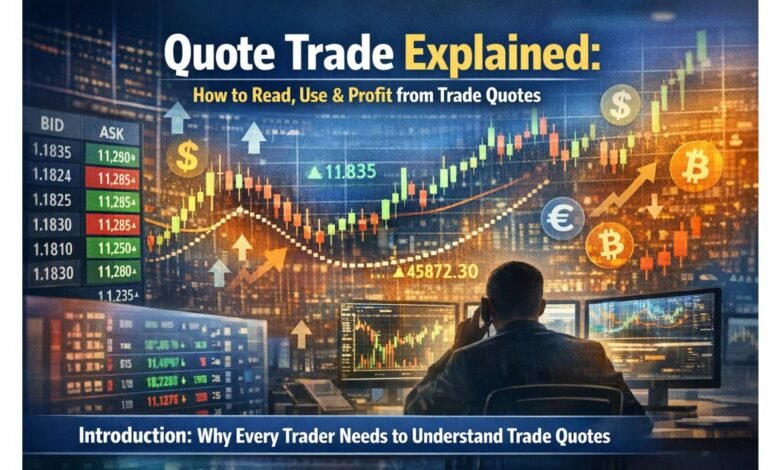
Introduction: Why Every Trader Needs to Understand Trade Quotes
There is a moment every new trader experiences — staring at a screen full of numbers, arrows, and flashing prices, wondering what it all actually means. At the centre of all that noise is a fundamental concept that drives every market decision: the quote trade.
Whether someone is buying their first stock, dipping their toes into forex, or exploring advanced strategies involving dark pool DEX and block execution crypto, it all starts with understanding what a trade quote is and how to read it properly.
A quote in trading is not just a price tag. It is a live snapshot of the market’s sentiment — showing what buyers are willing to pay and what sellers are willing to accept at any given second. Getting comfortable with this concept is not optional for serious investors. It is the foundation.
This guide breaks down everything a trader needs to know about the quote trade — from the basic components to advanced applications across different markets.
What Is a Quote in Trading?
At its simplest, a trade quote refers to the price at which an asset was last traded, or the price at which it can currently be bought or sold. It sounds straightforward, but there is quite a bit happening beneath the surface.
Every time a transaction takes place in the market — whether that is a stock changing hands on the NYSE or a token swapping on a decentralized exchange — the quote updates to reflect that new reality. These updates happen in milliseconds in modern markets, giving traders a near real-time view of where an asset stands.
One common point of confusion is the difference between a quote and the market price. While they are closely related, they are not always identical. The market price typically refers to the last confirmed transaction price, while the quote encompasses both the current bid and ask — what buyers want to pay versus what sellers are asking for. In fast-moving markets, that distinction can represent a meaningful difference in cost.
Accurate quotations are genuinely the backbone of trading. Without reliable quote data, traders would essentially be flying blind — placing orders without a clear picture of where an asset is actually priced in real time.
Key Components of a Trade Quote
Understanding a quote trade means knowing what each piece of data represents. Here is what shows up in a standard quote and what it means:
Bid Price
The bid price is the highest price a buyer is currently willing to pay for the security. Think of it as the demand side of the equation. When a trader wants to sell immediately, the bid is what they will receive.
Ask Price
The ask price — sometimes called the offer price — is the lowest price at which a seller is willing to part with the security. This is the supply side. When a trader wants to buy immediately, the ask is what they will pay.
Bid-Ask Spread
The spread is simply the difference between the bid and ask prices, and it quietly reveals a lot about market conditions. A tight spread generally reflects a liquid, heavily traded asset. A wide spread often signals lower trading activity, higher risk, or uncertainty in the market. For anyone involved in quote trade strategy, monitoring the spread is just as important as watching the price itself.
Last Price
The last price is the most recent price at which an actual trade was executed. It is a historical data point — useful for context, but not necessarily what a trader will get when they place their next order.
Volume
Volume tells traders how many shares, contracts, or units have changed hands during a given time period. High volume alongside a price move adds confirmation and credibility to that move. Low volume moves are often treated with more skepticism.
Open, High, Low, Close (OHLC)
The OHLC data paints a picture of price behavior over a session or time period. The open is where the asset started, the high and low bracket the range of movement, and the close is where it ended. Together, these four numbers tell a story that traders use to identify patterns and plan entries and exits.
Types of Trade Quotes
Not all quotes are created equal, and knowing the different types helps traders access exactly the information they need.
Firm Quotes
A firm quote is a price quote that a market maker or broker is genuinely committed to honoring. It is a legally binding statement — meaning the party issuing it is obligated to execute a trade at that price if someone acts on it within the standard conditions. Firm quotes give traders confidence that the price shown is real and actionable.
Indicative Quotes
An indicative quote, by contrast, is provided purely for informational purposes. It gives a general idea of where a price might be, but it carries no execution obligation. These are commonly used in over-the-counter markets and during pre-market or after-hours sessions when liquidity thins out.
Level 1 Quotes
Level 1 is the most basic form of market data — it shows the last price, the best bid, and the best ask at the top of the order book. Most retail brokerage platforms provide Level 1 data for free, and it is enough for casual investors making straightforward trades.
Level 2 Quotes
Level 2 data goes much deeper. It shows the entire consolidated limit order book — all the bids and offers stacked up across multiple price levels and market routes. Active traders rely on Level 2 to understand where price support and resistance exist in real time, and to gauge whether buying or selling pressure is building.
Level 3 Quotes
Level 3 access is reserved for broker-dealers and professional market participants. It provides complete order book visibility and allows participants to enter, modify, and execute quotes directly. Retail traders do not typically have access to this level.
How to Read a Trade Quote
Reading a trade quote is a skill that improves with practice. Here is what to focus on:
Ticker symbols are the shorthand identifiers for securities — like AAPL for Apple or BTC for Bitcoin. Every quote is attached to a ticker, so knowing how to look one up quickly is step one.
Interpreting bid/ask in real time means watching not just the numbers but the gap between them. A stock quoted at $50.10 bid / $50.12 ask has a very tight spread, suggesting high liquidity. If that same stock were quoted at $50.00 bid / $50.50 ask, that half-dollar spread would be a red flag for execution costs.
A security with a spread of zero is sometimes described as a frictionless asset — meaning there is essentially no cost to entering or exiting a position outside of commissions. These are rare in practice but are considered the ideal benchmark for liquidity.
Finally, comparing current quotes to historical ones helps traders identify trends. Is the bid consistently creeping higher? That is often a sign of increasing demand. Are sellers persistently undercutting each other? That may signal downward pressure ahead.
Quote Trade Across Different Markets
The concept of a quote trade applies across virtually every financial market, though the specifics vary:
Stock Market: Equity quotes display bid/ask spreads in cents or fractions of a cent for heavily traded stocks. ETFs follow the same structure, and spreads tend to be tight for popular funds.
Forex Trading: Currency pair quotes show two currencies in relation to each other — for example, EUR/USD. The base currency is what is being bought or sold, and the quote currency is what is used to make the purchase. Forex spreads can be extremely tight, especially for major pairs during peak hours.
Commodities: Oil, gold, and agricultural goods each have their own quoting conventions, often tied to futures contracts with standardized sizes and expiry dates.
Bonds and Fixed Income: Bond quotes are expressed as a percentage of par value rather than a direct price. Reading bond quotes requires understanding this convention.
Crypto Markets: Crypto quote trade activity runs 24/7 across both centralized exchanges and decentralized platforms. In decentralized environments — particularly those involving dark pool DEX structures — quotes work differently than in traditional finance. DEX quotes are often derived algorithmically via liquidity pools rather than through a traditional order book. This matters especially for traders exploring block execution crypto strategies, where large trades need to be handled without distorting market prices.
Quote Data vs. Trade Data
These two types of data are often confused, but they serve very different purposes.
Quote data captures the best bid and ask prices at any moment, along with the depth of the order book. It is most useful for pre-trade analysis — helping a trader figure out the best time and price at which to enter or exit a position.
Trade data records the actual transactions that have taken place — what price, how much volume, and when. This data is particularly valuable for backtesting strategies and building quantitative models because it reflects what really happened in the market.
Some traders strongly prefer trade data for strategy development because quote data, especially in complex environments, can include quotes that never actually lead to executed trades. In markets involving block execution crypto or dark pool DEX activity, the gap between quoted and executed prices can be significant — making trade data the more reliable source for model validation.
The Role of Market Makers in Quoting
Market makers are the behind-the-scenes players who keep markets liquid by continuously providing both buy and sell quotes for securities. Without them, traders would often struggle to find a counterparty for their orders.
A market maker is obligated to both buy and sell at their posted prices up to what is known as the normal market size — the standard lot size applicable for that particular security. This commitment is what makes their quotes reliable and keeps markets orderly during periods of high activity.
The tighter a market maker keeps their spread, the more competitive and liquid the market tends to be. When market makers widen their spreads — often during earnings announcements, economic news, or periods of extreme volatility — it is a signal that uncertainty is elevated and execution costs are rising.
In crypto markets, the role of market makers is sometimes filled by automated protocols, especially in dark pool DEX environments where liquidity is provided algorithmically rather than by identifiable human participants.
How Technology Has Transformed Trade Quotes
The evolution from physical ticker tape machines to real-time digital quote feeds is one of the most dramatic transformations in financial history. What once took minutes to disseminate now happens in microseconds.
Algorithmic trading has pushed quote updates to extraordinary speeds. High-frequency trading firms can generate and cancel thousands of quotes per second, making markets faster and in many ways more efficient — though this also introduces new complexities around quote stuffing and latency arbitrage.
Quote services have become democratised to a significant degree. Level 1 data is widely available for free through most brokerage platforms. Level 2 data typically requires a subscription or an active account with a platform that supports it. Advanced tools used by professional traders — particularly those monitoring block execution crypto flows or dark pool DEX activity — often require specialised data subscriptions.
Platforms like TradingView, Bloomberg Terminal, and individual broker dashboards have made it easier than ever for retail traders to access and interpret real-time quote data that was once reserved for institutional players.
Common Mistakes Traders Make with Quotes
Even experienced traders fall into these traps, and understanding them can prevent costly errors:
Relying on delayed quotes is one of the most common issues for traders using free data feeds. In fast-moving markets, a 15-minute delay is essentially useless for active trading decisions.
Ignoring the bid-ask spread when calculating trade costs is a mistake that quietly erodes profits. Every round-trip trade — entering and then exiting — costs the trader at least one full spread. On thinly traded assets, this can add up quickly.
Confusing the last price with the actual executable price catches many beginners off guard. Just because the last trade happened at $100.00 does not mean the next order will fill there. The ask might already be at $100.25.
Over-relying on Level 1 data for complex strategies is another pitfall. Without the depth that Level 2 provides, a trader cannot see where large orders are stacked and may be caught off guard by sudden moves driven by order book imbalances.
Practical Tips for Using Trade Quotes Effectively
Here are some actionable habits that stronger traders tend to develop:
- Always check both the bid and the ask before placing an order. Knowing both sides of the quote helps set realistic expectations for fill prices.
- Use Level 2 data to see where buyer and seller interest is concentrated. A wall of sell orders stacked just above the current price is a meaningful signal.
- Factor the spread into profit/loss calculations before entering a trade. If the spread is wide relative to the expected move, the risk-reward ratio weakens considerably.
- Monitor volume alongside quotes for trade confirmation. A price quote moving on thin volume is far less trustworthy than the same move backed by strong participation.
- In crypto environments, pay particular attention to execution methods. Strategies involving block execution crypto or dark pool DEX liquidity require an understanding of how those systems quote and fill orders differently from standard centralized exchanges.
Conclusion: Quotes Are the Language of the Market
At the end of the day, every successful trade begins with a clear understanding of a quote. Whether someone is just learning what a bid-ask spread means or deep into analyzing dark pool DEX flows for block execution crypto strategies, the quote trade concept sits at the center of all of it.
The market speaks in prices, and quotes are its vocabulary. Traders who take the time to understand how quotes work — how they form, how to read them, and how to act on them — are simply better equipped to make decisions that hold up over time.
The next step is straightforward: open a demo account, pull up a real-time quote feed, and start observing. Theory only goes so far. Watching live bid/ask data shift in response to market activity is an education that no article can fully replace. The market is always teaching — the question is whether traders are paying attention.
Also Read: Driving Business Success Through Customer Service Excellence Training and HR Solutions